
REAL CHOICE
FOR
REAL CHANGE
Elias Henry Montgomery
Across Utah, families are working harder but falling behind. Rent keeps climbing. Starter homes are disappearing. Even groceries and basic necessities cost more each month. At the same time, whether you vote blue or red, your representatives prioritize their party scripts over helping the community. I’m running to offer a real choice and real, tangible change: lower costs, real accountability, and a government that serves the people.
My Focus—

I’m a Utahn who has lived through the same hardships many of us face every day, like higher rent and housing costs. I’m running because the people of Utah deserve a representative who comes from their own ranks—someone who shares your struggles—not someone from a corporate boardroom or donor list. You pay too much, your vote matters too little, and parties are failing you. I have a plan to resolve these issues.
-
Utah doesn’t have a work ethic problem—it has a system problem.
Families are doing their part, but the basics keep getting harder to afford because too often the rules favor consolidation, speculation, and corporate leverage over everyday people.
My focus is simple: lower real costs for Utah families.
That means:
Housing that people who work here can afford—not just luxury units or investor‑owned homes.
Healthcare that doesn’t ambush families with surprise bills or opaque pricing.
Markets that reward honest competition, not price‑gouging or monopoly power.
I’m not anti‑business. Utah depends on strong local businesses.
But if a company profits by pushing costs onto families, taxpayers, or communities, that’s not free enterprise—it’s a rigged deal.My standard is straightforward: if a policy lowers costs for Utah families, I support it. If it protects corporate profits while people fall behind, I don’t.
-
When elections aren’t competitive, politicians stop listening.
Too many elected officials are protected by safe districts, big donor money, and party loyalty tests. When that happens, the incentive shifts away from solving problems and toward protecting power.
I support reforms that put voters back in charge:
Ending partisan gerrymandering so politicians don’t pick their voters.
Making room for independent voices so more Utahns are represented.
Creating legislatures that reflect real communities—not rigid party lines.
Accountability shouldn’t depend on party affiliation.
If you hold public office, you should answer to the people you serve. -
Utah works best when decisions are made close to the people they affect.
Too often, communities are told there’s “no choice” when it comes to housing, infrastructure, or development—while decisions are made far away by people who don’t live with the consequences.
I believe in:
Local communities having real say in how they grow and develop.
Investing in infrastructure and resilience that lowers long‑term costs—like energy efficiency, water security, and transportation that actually works.
Opportunity that’s rooted in place, so people don’t have to leave their hometowns to build a stable life.
This isn’t about ideology. It’s about practicality.
Strong communities aren’t built by centralized power or corporate shortcuts—they’re built by people who live, work, and raise families there.Bottom Line—
I’m not running to represent a party label.
I’m running to represent the people who live, work, and raise families in Utah.Real choice. Real change.

My Policy Agenda
Put local buyers first
Discourage large‑scale institutional purchase of single‑family homes and prioritize owner‑occupants, so Utah families aren’t outbid by distant investors.
Build homes normal paychecks can afford
Legalize and streamline “missing‑middle” housing (duplexes, townhomes, small apartments) so we can add practical supply—not just luxury units.
Fair Ballots: proportional party nominations
Parties should only be allowed to nominate candidates in proportion to their statewide voter affiliation.
Example: If a party has ~50% statewide voter affiliation, it can nominate candidates in ~50% of the elections for a 75‑seat legislature—about 38 nominees.
This does not guarantee seats. It simply prevents ballot crowd‑out and forces real competition.
End gerrymandering with independent maps
Politicians shouldn’t be able to draw districts to protect themselves. Independent redistricting makes elections competitive again.
Invest in savings, not slogans
Back infrastructure and resilience projects that lower long‑term household costs (energy efficiency, water security, practical transportation)—measured by results, not politics.
Local control with consistent rights protections
Move decisions closer to communities without sacrificing equal rights, due process, or consistent standards statewide.

My Standard
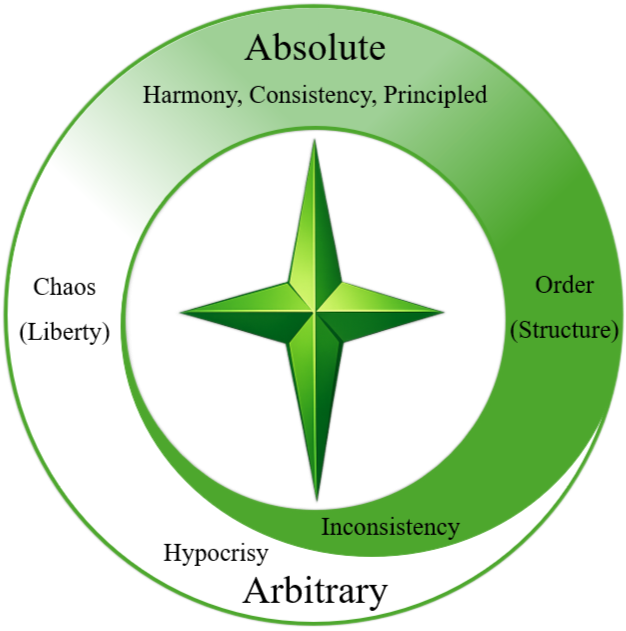
I use this compass to keep myself accountable—so my positions don’t change based on who’s in charge or who benefits more. If a policy’s validity depends on who holds power, the policy is arbitrary and detrimental.
Each issue is different—but the method is the same. You don’t have to agree with every conclusion to understand how I will lead.

This compass guides how I evaluate policy across every issue below.
This helps visualize the effect of governing interventions on our quality of life as citizens. From left to right, less intervention to more intervention.
We reach “Absolute” only when interventions are applied consistently and transparently to protect everyone’s rights and liberties. When standards shift with whoever holds power, we’ve slipped into the Arbitrary zone.
The ‘Absolute’ label is NOT authoritarian absolutism — it is the opposite: governance that restrains power through consistent principles.
-
Order skew: Forced equality of outcomes. Chaos skew: Wild‑west capitalism.
Harmony Resolution:
Equal rights to opportunity + anti‑capture protections.
• Strong antitrust enforcement
• Equal access to education & capital (for small businesses and working families)—based on transparent, objective criteria, not insider advantage, political influence, or consolidation.
• Public‑option banking for underserved communities
• No preferential treatment based on identity or income
Equal rights means equal legal standing—not blindness to real barriers or capture
Why this is harmony:
It uses voluntary forfeiture to restore fairness without coercive leveling.
-
Order skew: Government‑only, fully centralized care. Chaos skew: Pure unregulated market.
Harmony Resolution:
Universal baseline care + competitive private options.
• Universal catastrophic coverage (floor)
• Market competition for higher tiers (ceiling)
• Transparent pricing requirements
• Prevent monopolies + allow innovation
Why this is harmony:
Guarantees rights (life & health) while respecting choice (market adaptation).
-
Order skew: Single national narrative. Chaos skew: Every district invents its own truth.
Harmony Resolution:
National factual minimums + locally adaptable perspectives.
• Core factual standards (dates, events, civics)
• Local communities may add supplementary perspectives
• No group‑based guilt or political indoctrination
• Critical thinking emphasized over identity framing
Why this is harmony:
It blends shared national cohesion with agency for local expression.
-
Order skew: Near‑total prohibition
Chaos skew: No standards at allHarmony Resolution
Protect the right to self‑defense while regulating weapon privileges in a consistent, constitutional way.
You can keep your guns.
The government has no authority to confiscate or seize lawfully owned, licensed firearms from peaceful citizens.Right = access to sufficient defensive capacity
Every citizen retains the right to possess effective means of self‑defense.Privilege = expanded access to higher‑lethality weapon classes
Certain firearm types may require additional qualifications—without bans or blanket confiscation.Universal training requirement (like driver’s education)
Safety, competency, and accountability strengthen liberty rather than weaken it.Uniform background checks with due‑process protections
Clear standards, transparent review, and a guaranteed right to appeal.No identity‑based carve‑outs
Same rules, same rights, same responsibilities—for everyone.
Why this is Harmony
This approach respects the Second Amendment as a protected right, not an unlimited or arbitrary privilege—while rejecting both government overreach and reckless deregulation.
Liberty is preserved.
Rights are protected.
Confiscation is off the table. -
Some issues are harder than others. This framework is designed for exactly those cases. I don’t approach abortion as a party script. I use the same standard I apply to every issue: policies must be anchored in clear principles, balanced between necessary order and human agency, and consistent across cases. That’s what I mean by Absolute governance—and it’s why I reject partisan extremes.
On the compass, the order skew would be total ban; the chaos skew, anytime for any reason.
Harmony Resolution:
Protect both the pregnant patient and the developing child through a consistent, medically anchored, exception‑based framework that avoids partisan extremes.
Core Principles:
Abortion is not a viable form of discretionary birth control. I support a medically grounded, exception‑based framework that protects both patient safety and human life.
Exceptions allowed when one of the following applies:
Pregnancy results from rape or incest.
A qualified physician determines the pregnancy poses a serious threat to the mother’s life or major bodily functions.
A qualified physician determines the fetus has lethal or non‑viable anomalies incompatible with sustained life.
Implementation Standards:
Exception‑based cases require:
• A documented medical review,
• Informed consent,
• Optional counseling services,
• Transparent clinical documentation.Expand prenatal, postnatal, adoption, and maternal health support services for all pregnant individuals.
Why this is harmony:
It creates a clear, principled middle path that:
Protects human life,
Ensures patient safety,
Relies on medical evidence,
Provides consistent legal standards, and
Avoids both absolutist bans and unrestricted access.
-
Order skew: Hard closures, minimal entries. Chaos skew: Open borders.
Harmony Resolution:
A predictable, high‑throughput legal immigration system with flexible quotas.
• Screening, rule of law, predictable pathways are necessary.
• Quotas should adjust annually based on labor needs.
• Fast adjudication → replaces irregular entry with legal entry
• Universal due‑process protections
Why this works:
It preserves national security and agency while minimizing enforcement inconsistency and human suffering.
-
Order skew: Unaccountable, militarized enforcement with broad discretion.
Chaos skew: No meaningful enforcement, inconsistent outcomes, and loss of rule of law.
Harmony Resolution:
Accountable enforcement that is constitutional, identifiable, and measurable—focused on real threats, not chaotic public raids.
Core Principles:
• Rule of law must be paired with due process and transparency.
• Use of force must be independently reviewable.
• Enforcement should reduce public chaos by prioritizing predictable procedures over spectacle.
• Standards must be universal—no carveouts by identity, politics, or jurisdiction.
• Local cooperation is valuable when it reduces civilian harm and increases lawful processing.
Implementation Standards (measurable & enforceable):
1) Identification & Recording
• Require clear identification (uniforms/visible agency markers) during operations.
• Require body-worn cameras during public enforcement activity, with clear activation rules and penalties for noncompliance.
2) Warrants, Notice, and Due Process
• Require judicial warrants (or documented final orders where legally applicable) for home entry and arrests in sensitive contexts.
• Guarantee a clear, accessible appeal process for mistaken identity, status errors, or procedural violations.
3) Use-of-Force Accountability
• Establish independent investigations for use-of-force incidents (not self-investigation).
• Publish outcomes and disciplinary actions in a standardized reporting format.
4) Operational Focus: Reduce “Chaos Enforcement”
• Prioritize processing through established custody/transfer procedures rather than roving public arrests.
• Limit high-disruption operations in civilian spaces unless there is a specific, documented risk threshold.
5) Training & Professional Standards
• Set national training minimums, field proficiency evaluations, and recurring recertification.
• Require scenario-based de-escalation training and constitutional-rights training.
6) Transparency Dashboard (quarterly public reporting)
Publish standardized metrics such as:
• Body-cam activation compliance rates
• Use-of-force incidents and outcomes
• Complaint volume, investigation initiation, and resolutions
• Arrest categories (e.g., violent felony convictions, nonviolent offenses, no criminal record)
• Operational context (custody transfer vs. public arrest)
7) Protected Locations Policy
• Maintain clear restrictions on enforcement actions near schools, hospitals, courts, and places of worship—except under defined, high-threshold conditions.
Why this is harmony:
It preserves lawful enforcement (order) while protecting agency and rights (chaos) through consistent, transparent standards. Enforcement becomes predictable and reviewable—reducing fear, reducing mistakes, and increasing legitimacy without sliding into either militarized overreach or lawless inconsistency.
-
Order skew: Total police immunity. Chaos skew: Defund/abolish.
Harmony Resolution:
Professionalized, accountable policing with community integration.
• National training minimums
• Independent civilian oversight
• Officer safety must operate under the assumption of constitutional rights.
• Mental‑health responders for specific 911 call categories
Why this is harmony:
Increases trust, reduces harm, preserves necessary order, avoids anarchy.
-
Order skew: Mandatory conformity to religious norms. Chaos skew: Mandatory conformity to progressive norms.
Harmony Resolution:
Equal rights + protected conscience boundaries.
• Full civil rights for LGBTQ+ individuals
• No compelled speech or coerced religious participation
• Distinguish public accommodations (must be equal) from private rituals (protected)
• Universal anti‑harassment enforcement
Why this is harmony:
It balances agency on both sides—one of the hardest harmony‑tests.
-
Order skew: Immediate, coercive bans. Chaos skew: No environmental regulation.
Harmony Resolution:
Outcome‑based regulatory standards + innovation incentives.
• Set emissions targets, not technology mandates
• Reward innovations that hit targets
• Local flexibility for industries & climates
• Invest in resilience & grid modernization
Why this is harmony:
Protects long‑term order (ecological stability) through adaptive means.
What ties all of this together is method, not ideology.
Every position above comes from the same standard: clear principles, practical balance, and consistent application. I’m not promising easy answers—but I am committing to rules that don’t change with party pressure, donor influence, or who holds power. When government intervenes, it should do so openly, fairly, and in ways people can actually live under. That’s how we lower real costs, protect rights, and restore trust.
Absolute governance is simply the American promise fulfilled: liberty and justice — in principled harmony — for all.

Ideas don’t change systems on their own—people do.
This campaign is built to be accountable to voters, not large donors. That only works if it’s supported by people who believe representation should be principled, consistent, and grounded in real life.
If you believe Utah can do better than false choices and political theater, I invite you to be part of this effort.
Make an
impact today
Volunteer or donate today to support my mission.